MARPE Non-Surgical Jaw Expansion in Encinitas, CA
Non-surgical jaw expansion for adults. Done in-office, by your orthodontist.
MARPE — miniscrew-assisted rapid palatal expansion — widens the adult upper jaw by delivering expansion force directly to the bone, bypassing the teeth entirely. Dr. Liatti handles every step himself: the custom appliance and the temporary anchorage devices are placed in a single appointment, and he personally guides the months of expansion that follow.
MARPE works for many adults — but not all of them.
The ideal candidate for MARPE is an adult with a narrow upper jaw — confirmed by measurement on a 3D CBCT scan, a cone beam CT that captures the jaws, airway, and bone in three dimensions. The resistance of the palatal suture and surrounding bone increases with age, but how much resistance a given patient has varies significantly.
Dr. Liatti evaluates every potential MARPE patient with a comprehensive evaluation that includes a CBCT scan, measurements of the upper and lower jaws, and an assessment of bone density and skeletal resistance. He doesn't recommend MARPE based on age alone — he recommends it based on what he sees in your anatomy.
We've successfully expanded patients well into their fifties. Age is a factor, but it's not the deciding one.
A narrow jaw doesn't always look narrow.
You can need expansion without any visible sign of it. Some narrow jaws are obvious — a crossbite, crowding, trouble breathing through the nose. Many don't: the teeth compensate by tipping outward on top and inward on the bottom, and the smile looks normal while the jaw underneath stays narrow. Dr. Liatti measures the bone directly to identify whether the jaw itself is narrow, regardless of how the teeth have adapted.
- A crossbite, or significant crowding
- Mouth breathing, snoring, or a difficulty breathing through your nose
- You were told your jaw is too narrow — or that you'd need surgery to fix it
- Straight-looking teeth, but the symptoms above anyway
If MARPE alone isn't the right fit — because the skeletal resistance is too high or a different approach would serve you better — Dr. Liatti will say so and walk you through the alternatives.
If you snore, wake up tired, or can't breathe through your nose.
Many adults who find their way to MARPE aren't searching for orthodontics at all. They're tired of mouth breathing, snoring, restless sleep, or simply having a hard time breathing through their nose — and at some point, someone mentioned the upper jaw might be involved.
The anatomy, in one sentence
The palate is the floor of the nose. A narrow upper jaw means a narrow nasal floor and less room for the tongue, which can end up positioned down and back instead of resting against the palate. MARPE widens the jaw itself — and the nasal floor with it.
What it means for your symptoms
What that means for your symptoms depends on where your restriction actually is — and that's exactly what the 3D CBCT scan shows. Some patients breathe noticeably easier after expansion; for others, the obstruction sits elsewhere and expansion alone won't fix it. Dr. Liatti will tell you which case you are before anything begins.
Sound familiar? Your free consultation — with 3D imaging included — gives you the real answer.
Book Your Free ConsultationWhy traditional expansion doesn't work in adults — and what changed.
In children, the upper jaw has a growth seam running down the center of the palate — the midpalatal suture. A traditional expander can push this seam open because it's still flexible — its pressure travels through the teeth to the still-open suture, and the bone fills in behind it. MARPE works on the same principle: steady pressure opens the suture and the jaw widens. The difference is how the force reaches the bone.
Why adult jaws resist
In adults, it's not that simple. The midpalatal suture becomes increasingly resistant to expansion over time, and the upper jaw is connected to the surrounding bones of the midface, which resist expansion too. Pushing through the teeth can't generate enough force to overcome all of that resistance without damaging the teeth and the bone supporting them. For decades, the only way around this was surgery: a procedure called SARPE — surgically assisted rapid palatal expansion.
What changed about a decade ago
A traditional expander is bonded to the teeth: it pushes on the teeth, and because the teeth are anchored in the bone, the force carries through to the jaw. MARPE skips that middle step. The appliance connects directly to temporary anchorage devices, or TADs — tiny temporary mini-implants placed in the palatal bone — so each turn delivers force through the TADs straight onto the bone, bypassing the teeth entirely. That puts the force higher on the jaw, where the real resistance to widening sits.
The result is real skeletal expansion — the bone itself widens — not just dental tipping, where the teeth flare outward while the jaw stays the same size.1 Because the force never travels through the teeth, MARPE can expand the adult upper jaw without surgery and without the damage a conventional expander would cause.
From scan to expansion, step by step.
Scanned at your exam
The iTero scan from your new patient exam is merged with your CBCT x-ray — no extra appointment needed.
Designed and 3D-printed for you
Between visits, your custom appliance is planned, by Dr. Liatti, in three dimensions — each TAD positioned where your bone offers the best support — then 3D-printed to fit your palate exactly.
Placement day — one appointment
Dr. Liatti bonds the appliance in place and places the TADs under local anesthesia, all in about 90 minutes. At many practices the orthodontist refers you to an oral surgeon for the TADs — two offices, two appointments, two fees. Dr. Liatti handles it all himself: lower cost, fewer appointments, one clinician responsible for every step.
Expansion at home
You'll go home with instructions for turning the appliance — small, controlled turns with a key, on a schedule Dr. Liatti sets for your case. The expander stays in place while the new bone matures.
What a MARPE looks like in place.
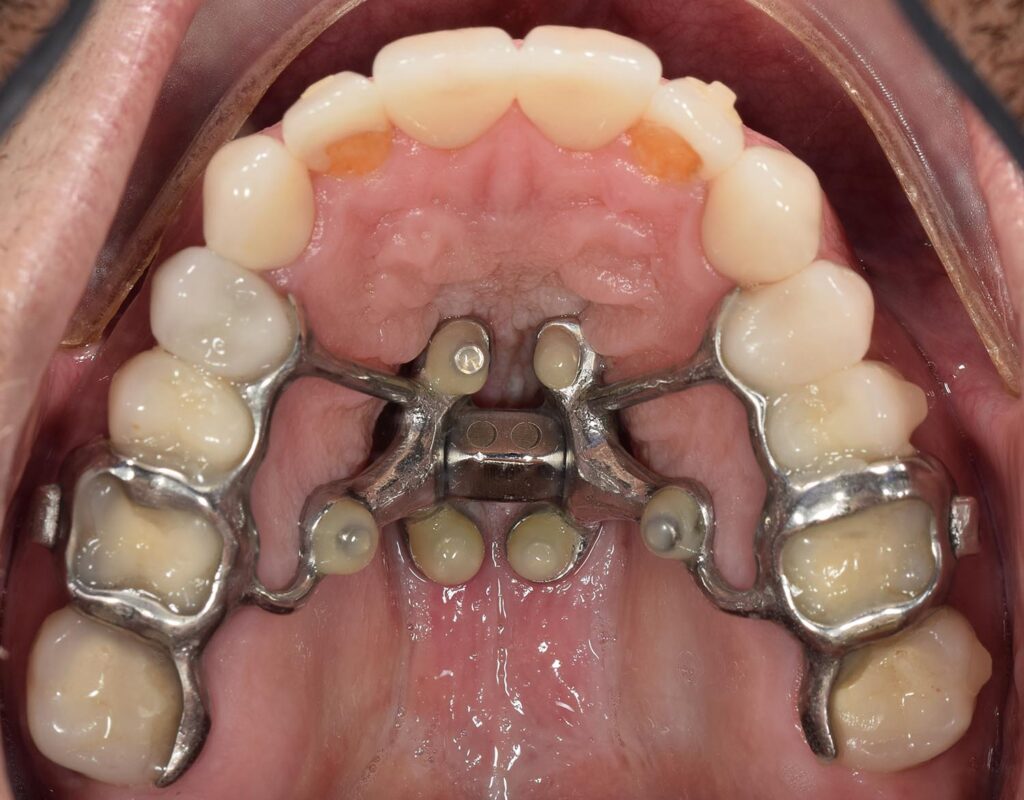
This is a MARPE seated against the roof of the mouth. The expansion screw sits at the center of the palate. The six small heads around it are the TADs, the temporary anchorage devices that anchor the appliance directly to the palatal bone; each one is covered in composite for patient comfort. The metal bands hold the appliance to the back teeth. All of it is placed by Dr. Liatti in a single appointment.
Each turn of the key opens the screw a small, controlled amount. Because the force travels to the bone through the TADs rather than through the teeth, the jaw itself widens, which is what makes expansion possible in an adult.
What to expect over the weeks and months that follow.
Each turn of the appliance delivers a small, controlled amount of force to the palatal bone. You'll feel pressure across the roof of your mouth, behind your nose, and in the bones connected to your palate. All of that is normal — it means the bone is responding. Dr. Liatti prescribes a turning schedule tailored to your case, and you'll follow it at home over the course of the expansion phase.
Keeping the gap small
Dr. Liatti uses a slow expansion protocol that keeps the gap between the upper front teeth as small as possible.
Some gap is expected — it's the clearest sign the jaw itself is widening — but expanding gradually minimizes it and makes the whole process more predictable. That keeps the aesthetic impact low, an important consideration for adults who are working and socializing throughout treatment.
Alignment starts sooner
Because the expansion phase is slower, it overlaps with the alignment phase of treatment — braces or Invisalign can begin while the expander is still in place. Starting alignment while expansion is still underway makes the whole treatment faster.
Once expansion is complete, the appliance remains in place while new bone fills in where the suture was opened — and is removed when the bone has consolidated enough to maintain the expansion on its own. From there, the alignment phase continues within the newly expanded arch.
What patients notice after MARPE expansion.
The upper jaw is physically wider — measurable on a follow-up scan and confirmed by the space created in the arch. Published systematic reviews report high success rates in appropriately selected patients,2 with durable skeletal expansion at long-term follow-up.3
The most common things patients report: easier breathing through the nose, more room for the tongue to rest on the palate, a broader and more attractive smile, and teeth that finally have the room they need for alignment. For patients who came in with a crossbite, it's corrected at the skeletal level — the upper jaw now fits over the lower jaw the way it should.
Results vary by patient. MARPE creates the structural foundation — the wider jaw — and the alignment phase that follows positions the teeth precisely within the new arch using braces or Invisalign.
MARPE versus surgically assisted expansion.
MARPE
SARPE
Dr. Liatti assesses anatomy to recommend the best approach for your case.
What MARPE costs.
$2,000–$4,000
2–4× higher
Added to comprehensive treatment. Covers the custom 3D-printed appliance and the TAD placement Dr. Liatti performs himself — no separate oral-surgeon fee. The surgical alternative typically runs two to four times as much, before hospital and anesthesia costs.
The cost of MARPE varies widely — by region, by practice, and most of all by what you're actually getting. Not every MARPE is custom: prefabricated versions exist, and they aren't planned around your anatomy, so the TADs end up where the appliance dictates rather than where your bone offers the best support. A fully custom appliance — designed from your merged iTero and CBCT scans and 3D-printed for your palate — is the standard at Encinitas Orthodontics.
Dr. Liatti places the temporary anchorage devices himself, in his own office, with no separate oral surgeon fee.
For many adults, the alternative route to a wider upper jaw is surgically assisted expansion — an operating room, general anesthesia, a surgeon's fee, and recovery time. MARPE is the less invasive path, and typically the far less costly one. You'll have your exact number, including payment-plan options, at the end of your free consultation.
What our patients say.
I recently finished my orthodontic treatment at Encinitas Orthodontics. I had an underbite but now it’s perfect. Dr. Liatti’s treatment method to move my teeth considered my overall health instead of just how the teeth looks, unlike other orthodontists who…
We love Dr. Liatti and his amazing staff! Our older son was treated for airway restriction/sleep apnea, and our younger son for a crossbite that would have permanently damaged his adult teeth.
We consulted with multiple orthodontists before and after meeting Dr. Liatti. We live quite far (1 hour drive) but it was 100% the right decision. Each of our children have received personalized care and treatment plans.
Dr. Liatti and his staff came in and saved me from a previously horrible Invisalign experience. Within two weeks, I had a new treatment plan (done the correct way with the latest technologies from a board certified orthodontist) and a new caring, funny…
I just finished my journey with braces through Encinitas Orthodontics/Dr. Liatti. He and his team are friendly and very knowledgeable.
I saw Dr. Liatti at Encinitas Orthodontics for a new retainer and was extremely impressed. As a speech and language pathologist, I appreciated Dr. Liatti’s thorough examination and was impressed with his wealth of knowledge.
Serving North County San Diego & beyond.
Encinitas Orthodontics is located at 317 N El Camino Real, Suite 203, in Encinitas, CA — serving families from across North County San Diego and the greater San Diego area who are looking for MARPE adult jaw expansion.
Patients visit from Encinitas, Carlsbad, Del Mar, Solana Beach, Rancho Santa Fe, San Marcos, and Oceanside.