Airway Orthodontics for Children in Encinitas, CA
How your child breathes shapes how their face grows.
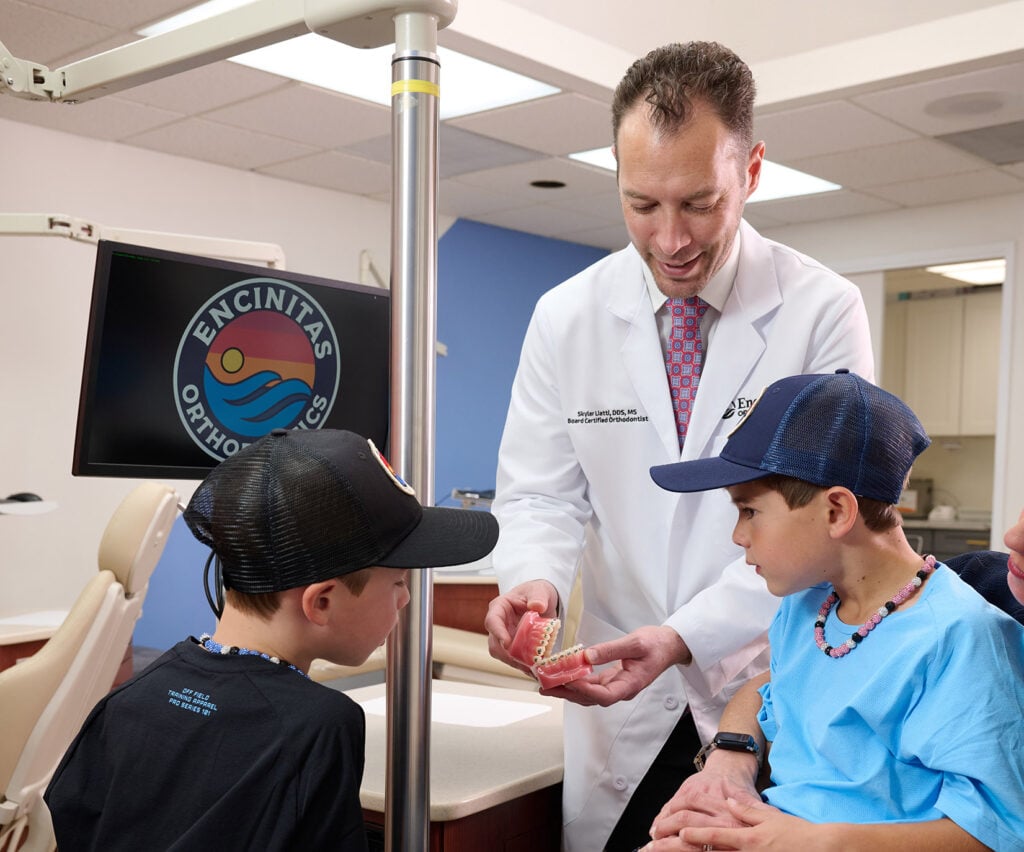
Mouth breathing, snoring, restless sleep — these aren't things most kids outgrow on their own. They're often signs that something structural is going on with the airway. Dr. Skyler Liatti screens for it at every child's first visit, because catching it during growth is when it's most treatable.
Signs that your child's airway may be part of the picture.
You don't need to know whether your child has an airway problem before coming in — that's Dr. Liatti's job. But these are the things parents and pediatricians often notice first.
Mouth breathing
A child whose lips are apart at rest — while watching TV, doing homework, sleeping — is usually breathing through the mouth. Chronic mouth breathing changes how the jaws and face develop over time.
Snoring
Snoring is not normal for children. It usually means airflow is being restricted somewhere — the nose, the throat, or both. Even light snoring is worth investigating.
Restless sleep
Tossing, turning, sweating, kicking the covers off, waking up tired, bedwetting in older children. When a child can't breathe well at night, sleep quality suffers — and so does everything that depends on sleep.
Dark circles under the eyes
Often called "allergic shiners," dark circles in children can be a sign of chronic nasal congestion and poor-quality sleep — both related to airway restriction.
Difficulty concentrating or behavioral issues
Sleep-disordered breathing is often missed in kids who present with ADHD-like symptoms — one study of children diagnosed with ADHD found more than half had measurable obstructive sleep events on overnight testing.1 A child who isn't sleeping well can't focus, regulate emotions, or learn the way they should.2
A narrow face, crowded teeth, or a recessed chin
These are often the visible result of jaws that haven't grown to their full width or length — which in many cases traces back to how the child has been breathing.
See your child in these signs? Airway screening is part of every free evaluation.
Book Your Free ConsultationHow breathing problems and jaw development are connected.

When a child can breathe comfortably through the nose, the lips stay closed and the tongue rests against the roof of the mouth. That tongue pressure helps the upper jaw grow wide and forward — it's like a natural mold shaping the palate from the inside.
When the nose is blocked — by enlarged tonsils, adenoids, allergies, or a narrow nasal passage — the child breathes through the mouth instead. The lips fall apart, the tongue drops to the floor of the mouth, and without that upward pressure, the upper jaw grows narrower than it should.3
A narrow upper jaw makes everything worse: the nasal floor gets narrower, the tongue sits low and back, and the lower jaw tends to follow it. Crowded teeth, an open bite, a long face, a recessed chin — these are often different stages of the same chain.3
It's more common than most parents realize.
Sleep-disordered breathing is a spectrum — from habitual snoring to upper airway resistance to obstructive sleep apnea. In children, even the mild end of that spectrum can affect growth, behavior, learning, and quality of life. The child doesn't have to stop breathing for there to be a problem — chronically restricted airflow during sleep is enough.
The structural causes often overlap with what Dr. Liatti sees in an orthodontic evaluation: a narrow upper jaw, a tongue that doesn't have room to sit on the palate, enlarged tonsils or adenoids pushing into the airway, or a lower jaw that sits too far back. These aren't things you can see by looking at your child's teeth — they show up on a 3D CBCT scan and a thorough clinical exam.
Dr. Liatti isn't a sleep physician, and he doesn't diagnose sleep apnea. But he is in a unique position to screen for the structural contributors — because he's already looking at the jaws, airway, and soft tissues as part of every child's evaluation. When he sees signs that suggest sleep-disordered breathing, he'll tell you what he's seeing and whether a referral to a sleep specialist or ENT is the right next step.
Tonsils, adenoids, and working with your child's ENT.

Enlarged tonsils and adenoids are one of the most common causes of airway restriction in children — and in many cases, they're the primary reason a child is mouth breathing, snoring, or sleeping poorly. A tongue tie can play a role too: when the tongue can't rest against the roof of the mouth, the upper jaw doesn't get the pressure it needs to grow wide.
Dr. Liatti screens for all of this during the evaluation. Tonsil and adenoid size show up on a 3D scan; tongue posture and restriction are part of the clinical exam. If something needs to be addressed before or alongside orthodontic treatment, he'll tell you what he's seeing.
When an ENT evaluation is the right next step, Dr. Liatti coordinates directly with your child's specialist — you're not the messenger between offices. You don't need to arrive with a diagnosis. That's what the evaluation is for.
Do you suspect your child has enlarged adenoids or tonsils affecting their breathing?
Book Your Free ConsultationHow Dr. Liatti treats the structural side of the airway.
When a child's upper jaw is too narrow — confirmed by direct measurement on a 3D scan — Dr. Liatti can widen it with a fixed rapid palatal expander. The expander opens the midpalatal suture, widening the jaw itself rather than just tipping the teeth outward. That means a wider nasal floor above,4 more room for the tongue on the palate,5 and more space for the permanent teeth.
Not every child with an airway concern needs orthodontic treatment. Sometimes the issue is primarily the tonsils and adenoids; sometimes the child is too young and the right answer is monitoring. Dr. Liatti will tell you what he'd recommend and what he wouldn't — and if the honest answer is "we should wait," the follow-up visits are at no charge.
For the children who do benefit from early intervention, the advantage is that their jaws are still growing — which is why Dr. Liatti recommends a first evaluation by age seven, consistent with the AAO's recommendation. Learn more about early treatment →
What our patients say.
I recently finished my orthodontic treatment at Encinitas Orthodontics. I had an underbite but now it’s perfect. Dr. Liatti’s treatment method to move my teeth considered my overall health instead of just how the teeth looks, unlike other orthodontists who…
We have been to several other orthodontists in the north county area for braces for my other two kids, but I switched to Dr. Liatti at Encinitas Orthodontics for my third child’s braces and he is unquestionably the best in the business!
We love Dr. Liatti and his amazing staff! Our older son was treated for airway restriction/sleep apnea, and our younger son for a crossbite that would have permanently damaged his adult teeth.
We consulted with multiple orthodontists before and after meeting Dr. Liatti. We live quite far (1 hour drive) but it was 100% the right decision. Each of our children have received personalized care and treatment plans.
I love that there was no push to do braces early and then having to have a phase 2 later. My son had his braces on less than 2 years total. I’m kind of suspicious of orthos who drag it out. Great experience here.
I saw Dr. Liatti at Encinitas Orthodontics for a new retainer and was extremely impressed. As a speech and language pathologist, I appreciated Dr. Liatti’s thorough examination and was impressed with his wealth of knowledge.
Serving North County San Diego & beyond.
Encinitas Orthodontics is located at 317 N El Camino Real, Suite 203, in Encinitas, CA — serving families from across North County San Diego and the greater San Diego area who are looking for airway-focused orthodontic evaluations for children.
Patients visit from Encinitas, Carlsbad, Del Mar, Solana Beach, Rancho Santa Fe, San Marcos, and Oceanside.