Orthodontic Technology in Encinitas, CA
The tools that let Dr. Liatti see what's actually going on.
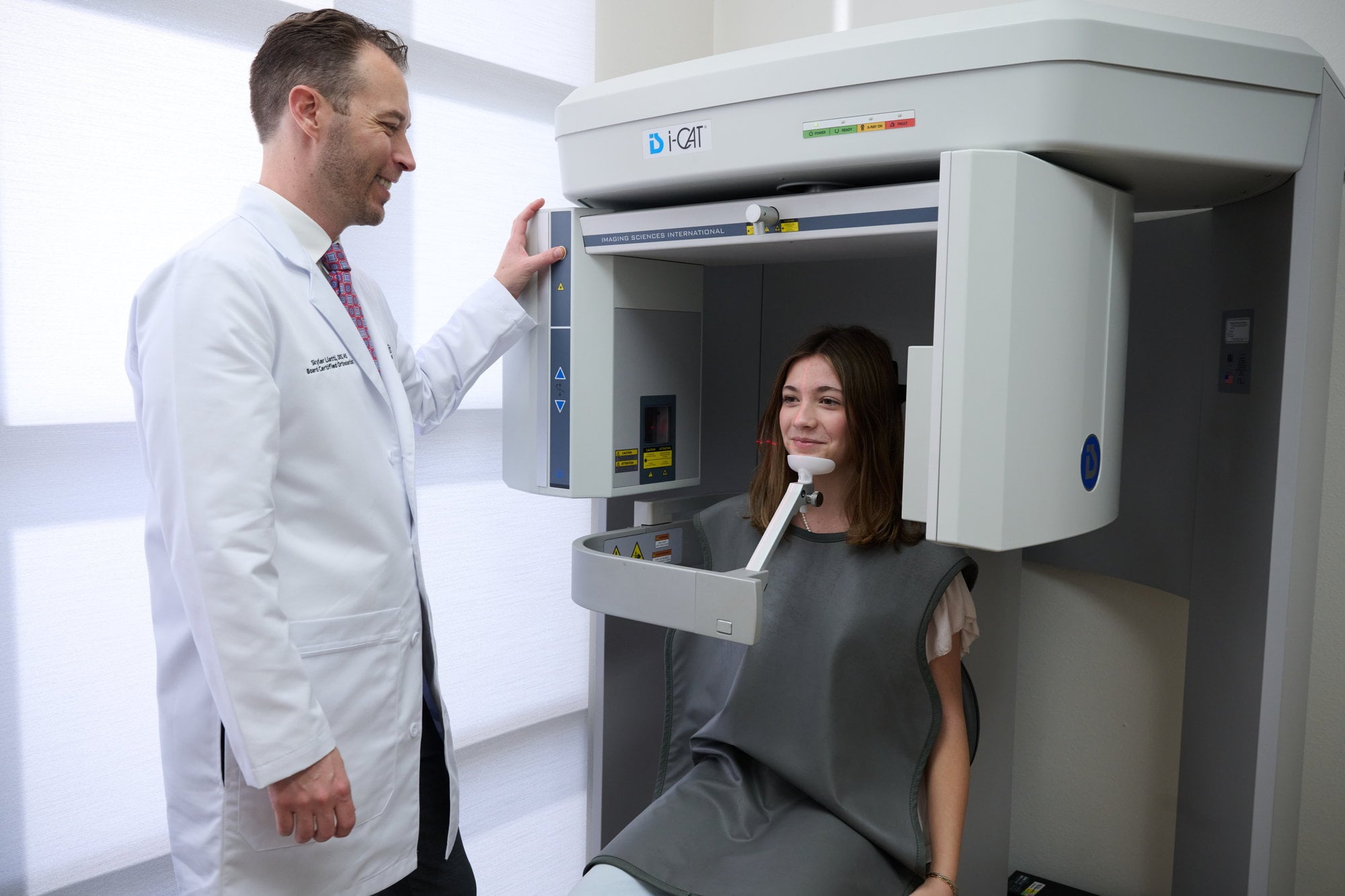
Technology on its own doesn't make a better orthodontist. But the right tools, used well, let Dr. Liatti see things a visual exam and a flat x-ray can't — the airway in three dimensions, the jaw joints from every angle, the position of unerupted teeth — and then carry out treatment as precisely as the diagnosis allows.

The i-CAT CBCT: three dimensions instead of two.
A cone-beam CT1 captures your teeth, jawbone, jaw joints, sinuses, and upper airway in three dimensions in about five seconds. Dr. Liatti uses an i-CAT CBCT as a standard part of his diagnostic process — every patient, every first visit.
What the 3D scan lets Dr. Liatti see
A single CBCT scan gives Dr. Liatti more than any combination of traditional x-rays. He can measure the actual widths of the upper and lower jaws, see the real volume of your airway, examine the surfaces of your jaw joints from any angle, find impacted or missing teeth still hiding in the bone, and identify skeletal asymmetries invisible on a flat image. The same scan generates the traditional panoramic and cephalometric views too — so one five-second capture replaces multiple separate x-rays.
About the radiation
Any x-ray involves some radiation, and we take that seriously. The i-CAT is a modern, low-dose unit, and every adult scan is captured on a low-dose protocol. For children, Dr. Liatti uses a separate pediatric setting that reduces the dose even further — because a child isn't a small adult, and the scan settings shouldn't treat them like one.23

The iTero digital scanner: no goopy molds.
The iTero is a small wand that builds a full 3D model of your teeth and bite in a few minutes — no trays, no putty, no gag reflex — and it's far more accurate than the old goopy impressions. Dr. Liatti uses the digital model to plan tooth movement, design Invisalign trays, set up indirect bonding, make retainers, and fabricate other appliances like expanders.
It's comfortable enough that kids who've never been scanned before handle it easily, which is why it's replaced traditional impressions for almost everything we do.

High-quality diagnostic photos.
At every first visit, we take a full set of high-resolution intraoral and extraoral photos with professional cameras. The goal is clear communication — Dr. Liatti uses these images to study your bite in detail, diagnose your case more accurately, show you exactly what he sees when he walks through his findings at the screen, and share specific views with your general dentist when coordination matters.
Every one of these diagnostics is included in your free first visit.
Book Your Free Consultation
Indirect bonding: brackets planned on a virtual model first.
Bracket position — by fractions of a millimeter — changes everything that happens afterward. When Dr. Liatti determines that precise bracket placement is critical to the case, he places the brackets virtually on a 3D model of your teeth with the finished result in mind, then transfers those exact positions into your mouth all at once using a custom tray. The wires do more of the work on their own, which means more efficient treatment with better results.

In-office 3D printing.
Having a 3D printer in the office means we make study models, indirect bonding trays, and the models our clear retainers are formed over — all in-house. If you need a replacement retainer, we print it here instead of sending it to an outside lab. If an appliance needs adjustment, the turnaround is days instead of weeks. It keeps the things that affect your timeline under our roof and under our control.

Self-ligating braces: less friction, fewer visits.
Instead of the elastic ties traditional braces use to hold the wire in place, self-ligating braces have a small built-in door — less friction, fewer places for plaque to hide, and often fewer adjustment visits. Dr. Liatti uses them when they're the right fit for the case. For some patients, he'll recommend traditional braces or Invisalign instead — the right tool is the one matched to your case, not the one with the best marketing.
All options — metal (silver), clear (ceramic), and gold (champagne) — are the same fee. No upcharge for choosing a less visible option.
The diagnostic tools are included in every free first visit.
The 3D CBCT scan, the iTero digital scan, and the clinical photos are all part of how Dr. Liatti does a first visit — and the first visit is free, for every patient, every time. The treatment tools above are built into your plan if you move forward — no hidden upgrade fees, no tiered pricing for the tools your case needs.
What our patients say.
I recently finished my orthodontic treatment at Encinitas Orthodontics. I had an underbite but now it’s perfect. Dr. Liatti’s treatment method to move my teeth considered my overall health instead of just how the teeth looks, unlike other orthodontists who…
I saw Dr. Liatti at Encinitas Orthodontics for a new retainer and was extremely impressed. As a speech and language pathologist, I appreciated Dr. Liatti’s thorough examination and was impressed with his wealth of knowledge.
I don’t like anything that has to do with my teeth. Haha. My dentist recommended that I revisit braces after having them as a kid. I had been told by other orthodontists that I wasn’t able to correct my teeth because of the recession areas I have.
From the moment you walk into Encinitas Ortho you’re greeted with a warm smile. The team takes you through a series of radiographs, photos and use the latest scanning technology to show you how to improve your bite and smile with Invisalign.
I am shocked how wonderful this office is! Everyone is so friendly, nice, and respectful which it makes me feel like a family to me. I had my aligners here and they did amazing job, starting from 3D prints to delivering the aligners.
Super friendly staff. Our 9 year old kid is working through an initial round and is having a good experience. We liked in the initial consult that Dr Liatti spent time discussing our CBCT scan (like an xray) and pointed out unrelated ENT issues we could…
Serving North County San Diego & beyond.
Encinitas Orthodontics is located at 317 N El Camino Real, Suite 203, in Encinitas, CA — serving families from across North County San Diego and the greater San Diego area who are looking for advanced 3D imaging and orthodontic technology.
Patients visit from Encinitas, Carlsbad, Del Mar, Solana Beach, Rancho Santa Fe, San Marcos, and Oceanside.