Surgical Orthodontics in Encinitas, CA
Some problems are deeper than the teeth.
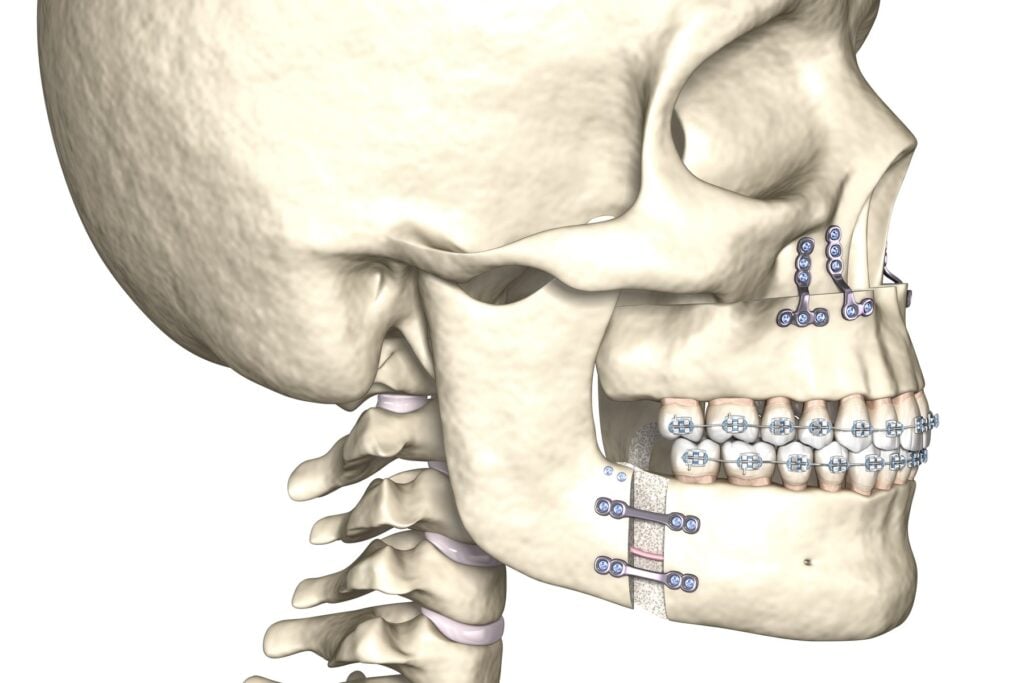
Orthodontics moves teeth within the bone — but when the bone itself is in the wrong position, there's a limit to what tooth movement can accomplish. Jaw surgery corrects the structure that braces and aligners can't reach. Dr. Skyler Liatti guides every surgical case from evaluation through final result — and he understands the process personally, because he's been through it himself.
Jaw Surgery Corrects What Braces Alone Can't
Surgical orthodontics — sometimes called orthognathic surgery — is a combined approach where an orthodontist and an oral surgeon work together to reposition the jaws. The orthodontist handles the teeth: aligning them so the bite fits correctly once the jaws are in their new position, then fine-tuning everything afterward. The oral surgeon performs the procedure.
The surgery repositions the upper jaw, the lower jaw, or both — depending on what needs to change. It's performed under general anesthesia, and recovery is measured in weeks, not months. The procedure today is far more predictable than it was even a decade ago.
When the upper jaw is too narrow, the lower jaw too far back, or the two have grown asymmetrically — the bite doesn't close properly, the airway narrows, and the facial profile shows it. Moving the jaws puts the teeth, the breathing, and the face into the position they need to be in to work together.
Who Needs Surgical Orthodontics?
Surgical orthodontics is typically recommended for adults whose jaw growth is complete and whose jaw discrepancy goes beyond what braces or aligners can correct on their own. The situations that lead patients here include a lower jaw that sits significantly ahead of or behind the upper, an overbite or underbite where the skeletal position is the cause, an open bite where only the back teeth touch, and noticeable asymmetry between the left and right sides of the face.
Airway is often the reason patients need surgical orthodontics in the first place. When the jaws are undersized or positioned too far back, the space behind the tongue narrows — affecting breathing, sleep quality, and daily energy. Repositioning the jaws opens the airway structurally — something orthodontics alone cannot do.
Severe TMJ dysfunction is another reason patients end up here. When jaw joint pain traces to the jaw position itself, repositioning the jaws can address the mechanical cause — and Dr. Liatti evaluates the joints directly on the 3D scan before drawing that conclusion.
Wondering if surgery is right for you?
Book Your Free ConsultationHow Surgical Orthodontics Works — Three Phases
Surgical repositioning
The oral surgeon repositions the jaws according to the plan Dr. Liatti helped design, under general anesthesia. Most patients are back to light daily activity within a week or two — and the jaws aren't wired shut. Heavy elastics hold them in position while you heal on a soft-food diet.
Orthodontics after surgery
Dr. Liatti continues treatment to settle the teeth into their final positions and refine the bite. This phase is typically shorter since the major structural change has happened. He walks you through a detailed timeline during planning so you know what to expect at each stage.
The Orthodontist's Role in Jaw Surgery
In surgical orthodontics, the orthodontist is often the one who identifies the need for surgery in the first place — through 3D imaging, measurements, and a full assessment of how the jaws relate to each other and to the airway. From there, Dr. Liatti helps determine which surgical approach will produce the best result, coordinates directly with the oral surgeon, and manages the orthodontic treatment that bookends the procedure.
This coordination matters because the surgical result depends on how well the orthodontic plan and the surgical plan fit together. The teeth need to be in the right position for the bite to work once the jaws are moved. When both sides are built together from the start, the teeth fit the new jaw position precisely and the final result is stable.
Dr. Liatti works with experienced oral surgeons he trusts and refers to regularly. If you already have a surgeon, he's happy to coordinate with them directly.
Dr. Liatti Has Been Through Jaw Surgery Himself

As a child, Dr. Liatti couldn't breathe well through his nose. He breathed through his mouth, his tongue rested low, and his upper jaw never grew to its full width. Over time, his lower jaw grew down and back, leaving him with an open bite — only his back teeth touched when he bit down — a recessed chin, and a gummy smile. The only real fix, as a young adult, was orthognathic surgery.
That surgery changed his life — and it's what drove him into orthodontics. He knows what the recovery feels like, what the uncertainty beforehand feels like, and what it means to come out the other side with a bite and a face that finally work the way they should.
When he walks a patient through what's waiting on the other side of surgery, he's not repeating something from a textbook. Learn more about Dr. Liatti →
Sometimes the answer is simpler than you've been told.
If you suspect you might need jaw surgery, a comprehensive evaluation is the best place to start.
Dr. Liatti's evaluation includes 3D imaging that measures the jaws directly — not a visual estimate — so the recommendation is based on what the anatomy actually shows.
Some patients who come in expecting surgery discover that their case can be treated with orthodontics alone, or with non-surgical jaw expansion (MARPE) combined with braces or Invisalign. Others confirm that surgery is the right path — and leave with a clear, coordinated plan.
Either way, you'll understand your options. Dr. Liatti will show you the imaging, walk you through the findings, and explain what each approach can realistically achieve. If surgery is the recommendation, you'll know exactly why — and if it's not, you'll know that too.
What our patients say.
I recently finished my orthodontic treatment at Encinitas Orthodontics. I had an underbite but now it’s perfect. Dr. Liatti’s treatment method to move my teeth considered my overall health instead of just how the teeth looks, unlike other orthodontists who…
We have been to several other orthodontists in the north county area for braces for my other two kids, but I switched to Dr. Liatti at Encinitas Orthodontics for my third child’s braces and he is unquestionably the best in the business!
We love Dr. Liatti and his amazing staff! Our older son was treated for airway restriction/sleep apnea, and our younger son for a crossbite that would have permanently damaged his adult teeth.
We consulted with multiple orthodontists before and after meeting Dr. Liatti. We live quite far (1 hour drive) but it was 100% the right decision. Each of our children have received personalized care and treatment plans.
Dr. Liatti and his staff came in and saved me from a previously horrible Invisalign experience. Within two weeks, I had a new treatment plan (done the correct way with the latest technologies from a board certified orthodontist) and a new caring, funny…
I love that there was no push to do braces early and then having to have a phase 2 later. My son had his braces on less than 2 years total. I’m kind of suspicious of orthos who drag it out. Great experience here.
I just finished my journey with braces through Encinitas Orthodontics/Dr. Liatti. He and his team are friendly and very knowledgeable.
I saw Dr. Liatti at Encinitas Orthodontics for a new retainer and was extremely impressed. As a speech and language pathologist, I appreciated Dr. Liatti’s thorough examination and was impressed with his wealth of knowledge.
Serving North County San Diego & beyond.
Encinitas Orthodontics is located at 317 N El Camino Real, Suite 203, in Encinitas, CA — serving families from across North County San Diego and the greater San Diego area who are looking for surgical orthodontics and jaw surgery coordination.
Patients visit from Encinitas, Carlsbad, Del Mar, Solana Beach, Rancho Santa Fe, San Marcos, and Oceanside.