Palatal Expansion in Encinitas, CA
There's a difference between widening the jaw and tipping the teeth.
When a child's upper jaw is too narrow, the goal is to widen the bone itself — not push the teeth outward. A fixed rapid palatal expander (RPE) separates the midpalatal suture, the growth seam down the center of the upper jaw,1 producing true skeletal expansion: a wider jaw, a wider nasal floor, and room for the permanent teeth.
Mouth breathing, a narrow jaw, and low tongue posture are all connected — and they reinforce each other.
It usually starts with something that makes nasal breathing harder — enlarged adenoids, allergies, or a tongue tie that keeps the tongue from resting on the palate. When a child can't breathe well through the nose, they breathe through the mouth. When the mouth is open, the tongue drops low. And when the tongue isn't resting on the palate, the upper jaw loses the force that helps it grow to full width. The jaw narrows.2
This creates a feedback loop that makes things worse over time: the upper jaw is the floor of the nose.
A narrower jaw means a narrower nasal passage — which makes nasal breathing even harder, which reinforces the mouth breathing, which keeps the tongue low, which keeps the jaw narrow. Each problem feeds the others.
This is why Dr. Liatti doesn't treat a narrow jaw as a tooth problem. It's a structural problem with consequences for the bite, the airway, the tongue posture, and the way the face develops. Expanding the upper jaw breaks the cycle at the structural level — widening the jaw, the nasal floor, and the space for the tongue all at once. A meta-analysis of pediatric expansion studies3 confirms that RPE measurably improves nasal airflow. When the original cause also needs attention — adenoids, a tongue tie — Dr. Liatti coordinates with the appropriate specialist.
A narrow jaw doesn't widen on its own — find out where your child stands, free.
Book Your Free ConsultationDr. Liatti didn't just study this pattern. He lived it.
I couldn't breathe well through my nose as a kid, so I breathed through my mouth. My lips stayed apart, my tongue dropped away from the roof of my mouth, and my upper jaw never grew to its full width. The narrow jaw made nasal breathing even harder — which kept the cycle going. Over the years, my lower jaw grew down and back, I ended up with an open bite, a recessed chin, and a gummy smile — and the only real fix, as a young adult, was jaw surgery.
When I see a child with a narrow palate and the same pattern starting, I know exactly where it leads. And I know that a few months with an expander during the growth window can change the entire trajectory.
A fixed appliance that separates the growth seam of the upper jaw.
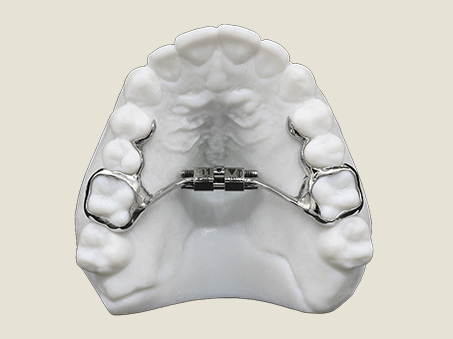
A rapid palatal expander is a fixed appliance cemented to the upper teeth. It delivers controlled, steady pressure across the palate — enough to open the midpalatal suture, the growth seam running down the center of the upper jaw. In a growing child, this seam is still open and responsive to expansion force.
A parent or the patient turns a small key built into the appliance, usually once or twice a day for a few weeks. Each turn widens the expander slightly. Over the course of active expansion, the suture separates, new bone fills in behind it, and the jaw is permanently wider.
After the active turning phase, the expander stays in place for several months while the new bone solidifies. Most kids adjust within a few days — the most common thing parents report is that it was easier than they expected.
The changes go beyond the teeth.
A wider jaw
The upper jaw is physically wider — measurable on a follow-up scan. That creates room for the permanent teeth to come in straight, instead of crowding into a jaw that's too narrow for them.
A wider nasal floor
The floor of the nose widens along with the palate, decreasing resistance to airflow through the nasal passage. In some children, this lessens the impact of enlarged adenoids on breathing.
Crossbite correction
When the upper teeth bite inside the lowers, expansion corrects it at the skeletal level — the upper jaw now fits over the lower jaw the way it should, preventing asymmetric jaw growth.
Room for the tongue
A wider palate gives the tongue space to rest up and forward against the roof of the mouth. Together with improved nasal breathing, this helps break the cycle of mouth breathing and low tongue posture.
Ready to explore how palatal expansion can help your child?
Book Your Free ConsultationNot all expanders are equal.
Removable expanders — including clear aligner-based expanders and various light-wire designs — work differently from a fixed RPE. They produce movement primarily by tipping the teeth outward rather than separating the underlying bone. The teeth move, but the jaw doesn't widen in the same way.
When Dr. Liatti's goal is true skeletal expansion — widening the jaw itself, opening the nasal floor, creating permanent structural change — the evidence supports a fixed RPE4 as the more reliable tool. A removable appliance simply cannot deliver enough sustained force to separate the midpalatal suture.
This doesn't mean removable expanders have no role. Dr. Liatti measures the jaw directly on a 3D CBCT scan before recommending any expansion. If the jaw is narrow, he'll show you the measurement and explain why a fixed expander is the right tool. If the jaw is fine and the teeth just need alignment, he'll recommend a different approach — or tell you to wait. The recommendation always follows from what the scan shows.
This works best during growth — and the window doesn't stay open forever.
In a growing child, the midpalatal suture is still open and responsive. A fixed RPE separates it cleanly, producing true skeletal expansion with minimal dental tipping. As a child gets older, that seam interlocks and stiffens.5 By the mid-teens, most of the expansion movement becomes dental rather than skeletal.
By adulthood, a traditional expander can't open the suture at all. The only options at that point are MARPE — which uses miniscrews to bypass the teeth and deliver force directly to the bone — or surgery.
This is why Dr. Liatti screens children by age seven — not to start everyone on treatment, but to identify the ones for whom the growth window makes a structural difference. A narrow jaw caught at eight or nine can be corrected in a matter of months. The same jaw at twenty-five requires a significantly more complex procedure.
What our patients say.
We love Dr. Liatti and his amazing staff! Our older son was treated for airway restriction/sleep apnea, and our younger son for a crossbite that would have permanently damaged his adult teeth.
I love that there was no push to do braces early and then having to have a phase 2 later. My son had his braces on less than 2 years total. I’m kind of suspicious of orthos who drag it out. Great experience here.
Dr Liatti and his team are truly excellent and they did an amazing job helping to fix my son’s bite and straighten his teeth.
Dr. Liatti and his staff are amazing!! They are very professional in every aspect of what they do. My son was 6 years old when he started to see Dr. Liatti, they have treated him with kindness, patience and have made him feel so comfortable every step of the…
We love the approach of Dr. Liatti. He is a bit more conservative and thinks long term instead of just recommending braces immediately at an early age. We are very happy with the office.
Super friendly staff. Our 9 year old kid is working through an initial round and is having a good experience. We liked in the initial consult that Dr Liatti spent time discussing our CBCT scan (like an xray) and pointed out unrelated ENT issues we could…
Serving North County San Diego & beyond.
Encinitas Orthodontics is located at 317 N El Camino Real, Suite 203, in Encinitas, CA — serving families from across North County San Diego and the greater San Diego area who are looking for palatal expansion and RPE treatment.
Patients visit from Encinitas, Carlsbad, Del Mar, Solana Beach, Rancho Santa Fe, San Marcos, and Oceanside.